
At RIDE-TOURISM, we hear from riders all over the world — North America, Europe, Asia, the Middle East, and beyond — and quite a few of them are dreaming big. One request that keeps coming up is the “Japan crossing” tour.
It might sound like a niche request, but I’ve personally fielded six inquiries about it just this year alone. Two of those groups are seriously planning to make it happen, which honestly impresses me every time.
So I thought I’d put together a rough outline of what a two-month, end-to-end Japan tour could look like — starting from Kyushu in the south and finishing up in Hokkaido in the north.
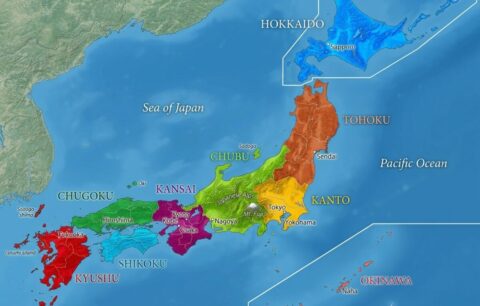
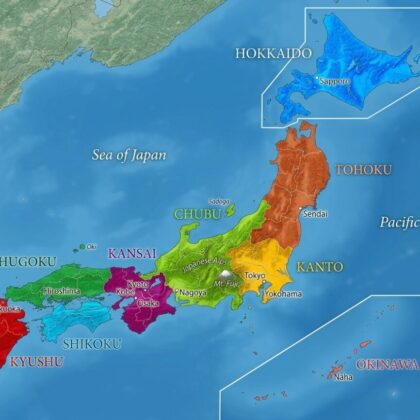
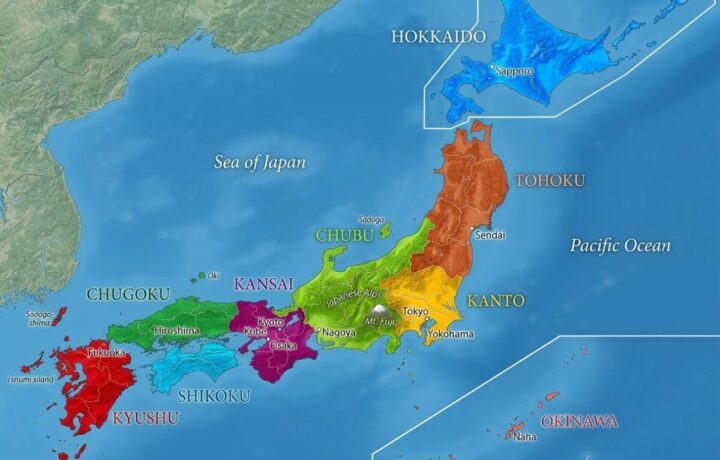
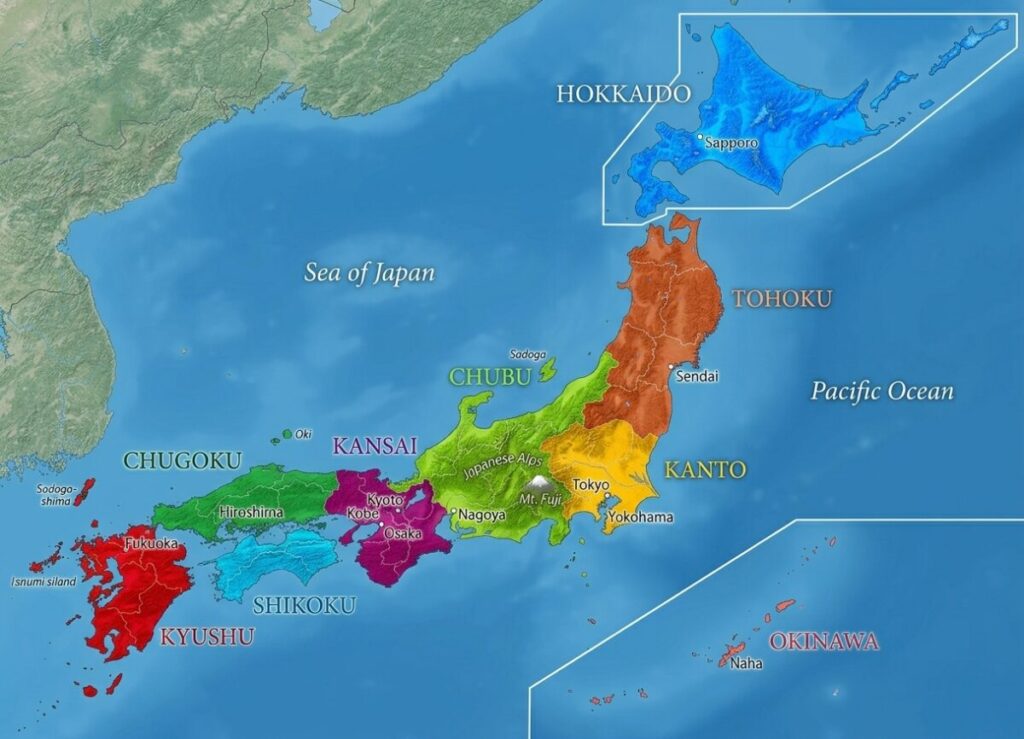
To make it easier to follow, I put together a color-coded map of Japan (AI-generated, so please forgive any misplaced place names — the colors are what matter here!).
When to start, and from which end
Depending on your travel dates, starting from Kyushu (the red zone) works best from spring onward, while starting from Hokkaido (the blue zone) suits an autumn departure. The reason is simple: comfort on the road.
Japan has a huge temperature range from south to north. Hokkaido and Tohoku (the orange zone) are proper snow country, and winter riding there just isn’t realistic — unless you’re one of those hardcore riders who genuinely enjoys riding through snow (they exist, and I respect them).
Even in spring, Hokkaido can still be cold. If you want a comfortable ride, heading from south to north between spring and summer is the way to go.
Starting the trip: our office and the ferry to Fukuoka
You could absolutely start a one-way plan straight from Kyushu. But here’s something worth considering first: shipping bikes down to Kyushu runs about ¥250,000. We can transport up to two bikes for that price, but beyond that, costs add up quickly.
If your schedule allows a bit of extra time, there’s a better way — start from our office and take the ferry down to Fukuoka yourself.
Our office is in an area called Shonan, just outside Tokyo.
RIDE-TOURISM Office — Shonan View on Google MapsThe name might not mean much if you’re visiting from overseas, but Shonan is a popular area among Japanese travelers — think of it as the town right next to Kamakura. It’s about an hour by train from central Tokyo, and easily reachable from both Haneda and Narita international airports.
Why not start your trip right here at our office? We’ll check over the bikes together, and if you need any rental gear, we can sort out helmet and jacket sizing on the spot. From here, it’s about an hour by road to the Fukuoka ferry terminal.
Ferry Terminal — Route to Fukuoka View on Google MapsSince it’s a long journey ahead, it might also be worth stopping at a large motorcycle gear shop nearby to pick up your own helmet before boarding.
Motorcycle Gear Shop (Tax-Free) View on Google MapsRouting through here, you can still reach the ferry terminal in about 2–3 hours — a great warm-up ride before the real journey begins.
Warm-Up Route to the Ferry Terminal View on Google MapsThe ferry departs at 11:45 PM and arrives the following night around 9:00 PM. Passenger fare runs about ¥6,000–7,000 per person, with motorcycle transport at around ¥15,000 per bike.
⛴ Ferry booking site (English)Compared to our one-way rental plan, this route saves a significant amount of money, gets you an overnight aboard the ship, and honestly makes for a great memory in itself. Just try not to get seasick!
Japan’s major cities — a quick note
Japan is often said to have five major cities: Tokyo, Osaka (the purple zone), Nagoya (the light green zone), Fukuoka, and Sapporo (the blue zone). These days, Yokohama has actually overtaken Nagoya in terms of scale and energy, so some people count it as a sixth major city. Yokohama happens to be right near our office too — definitely worth a visit!
Fukuoka: your first stop
The ferry lands in Fukuoka, one of Japan’s five major cities.
Fukuoka does have a reputation for having a few less safe pockets, but honestly, it’s nowhere near as bad as people assume. (I’ve traveled to quite a few countries myself, and Japan’s “bad areas” are still pretty tame by international standards!)
Fukuoka isn’t really a sightseeing city so much as a food city — similar in feel to Osaka in that sense. The three local specialties to try are:
- Motsunabe — a hotpot made with beef or pork offal. It’s a beloved Japanese comfort food, but it can be an acquired taste for first-timers.
- Hakata ramen — honestly, my personal opinion is that you’ll find better versions in Tokyo. Authentic Hakata ramen has a pretty strong smell that not everyone loves. If you want a gentler introduction, try a nationwide chain like Ippudo or Ichiran first — if you enjoy that, the real deal is worth a shot.
- Mentaiko (spicy marinated cod roe) — this is the safest bet by far. It pairs beautifully with beer, sake, wine, or whiskey, and almost everyone ends up liking it.
Nagasaki: next on the list
After Fukuoka, I’d recommend Nagasaki next. It has a genuinely unique atmosphere. I stayed at a hotel there once and was surprised to find most of the other guests were foreign travelers.
Locals tend to love Nagasaki’s nightlife district and Chinatown. For sightseeing, the standout is the Gunkanjima (Battleship Island) boat tour — a UNESCO World Heritage site and one of the most popular tours in the region.
🏝 Gunkanjima Cruise — Official SiteMore Kyushu highlights
Sightseeing
Kumamoto Castle One of Japan’s three great castles — restoration work is part of the appeal Sakurajima, Kagoshima An active volcano still emitting smoke — easily reached by ferryFor riders
Mount Aso — the Aso Panorama Line is a breathtaking motorcycle route with sweeping views. The Yamanami Highway, connecting Aso and Beppu, is another rider favorite, known for its winding roads.
Hot springs
- Kurokawa Onsen — a beautifully preserved, old-fashioned hot spring town
- Beppu Onsen (Oita) — one of the most famous hot spring towns in Japan, with the highest source count and volume in the country
- Takachiho Gorge (Miyazaki) — mythological roots, gorge boat rides, and a stunning waterfall
- Aoshima — a striking rocky coastline nicknamed the “Devil’s Washboard”
Depending on how deep you want to go, I’d budget around 7–10 days for Kyushu overall.
Heading into the Chugoku region
Once you’ve wrapped up Kyushu, it’s time to head north into the Chugoku region (the dark green zone).
There’s one stop you shouldn’t skip, located toward the southern end of this region: Motonosumi Shrine.
Motonosumi Shrine A dramatic row of torii gates set against a cliffside coastline — an absolute must-seeThat said, a few places are worth calling out:
Akiyoshidai Plateau & Akiyoshido Cave Japan’s largest karst plateau, with an equally impressive limestone cave Hagi Old Town A castle town from the final years of the samurai era, with well-preserved streets Izumo Taisha Grand Shrine Famous as one of Japan’s most important shrines, associated with matchmakingPersonally, I think Hiroshima is the true highlight of the Chugoku region — the liveliest city and the one with the most to see. Nearby, a short ferry ride away, is one of Japan’s most iconic sights:
Miyajima — Itsukushima Shrine The floating torii gate — one of Japan’s defining images, and a World Heritage SiteIt’s not “sightseeing” in the traditional sense, but Hiroshima’s Peace Memorial Museum and the Atomic Bomb Dome draw huge numbers of both Japanese and international visitors, with English signage throughout. It’s a place that stays with you.
Atomic Bomb Dome & Peace Memorial Museum A profound and reflective place to visit — at least onceShould you skip Shikoku?
The next region on the map is Shikoku (the light blue zone) — and honestly, you might want to skip it entirely. Here’s why:
If your goal is to circle the entire country or check off every region, you should absolutely go. But if your goal is specifically a “Japan crossing,” it’s not essential. A few reasons:
- Detouring into Shikoku adds a significant amount of backtracking
- The mountainous terrain makes for demanding riding
- It’s one of the most sparsely populated regions in Japan
- What Shikoku offers — shrines, hot springs, nature — you can already find in abundance elsewhere on the route
Of course, if there’s something specific there you want to see and you have the days to spare, it’s absolutely worth a detour.
Into the Kansai region
Skip Shikoku, and you’re on to Kansai (the purple zone).
You’ll likely enter through Hyogo Prefecture first, home to the famous Himeji Castle.
A quick personal tip: years ago, I stayed at a dormitory-style guesthouse in Hyogo that’s stuck with me ever since.
🛏 Kobe Maya GuesthouseAsk the owner nicely, and for about ¥2,000 they’ll take you on a walking tour of the nearby shopping street, complete with local food. When I stayed there, the place was full of foreign travelers — it seems to be something of a hidden gem. Nearby, there’s also a lesser-known spot called Mt. Maya worth checking out.
⛰ Mt. MayaKyoto and Osaka probably need no introduction. My advice: park the bike at your hotel and get around on foot or by train — it’s simply more efficient in these cities.
South of here, the Kii Peninsula is a genuinely popular region for motorcycle touring, with scenic routes along the way. In Matsusaka, you can try famous Japanese wagyu beef at surprisingly reasonable prices.
North of the Kansai region is Lake Biwa — again, probably needs no introduction, with plenty of sightseeing nearby and a route that’s popular with riders too.
How long to spend in Kansai really depends on your group. If you’ve already visited Osaka and Kyoto before, 4–5 days might be enough. First-timers might want a week or more.
If you’re staying in Kyoto, I know a great budget-friendly, high-quality hostel that’s popular with international travelers — no fancy meals, but a solid place to base yourself for a few nights.
🏠 Recommended Kyoto HostelOne thing worth planning around: the Kii Peninsula and Lake Biwa sit in roughly opposite directions from each other, which can be a bit of a headache if you’re short on time. Whether you pick one, or fit in both, is worth thinking through in advance.
Chubu region: the heart of the trip
Next is the Chubu region (the light green zone) — and this might just be the highlight of the entire journey.
First stop: Nagoya, one of Japan’s five major cities. Admittedly, it’s not always a “must-visit” for international travelers. But personally, I think it has a lot to offer, depending on your interests. One underrated spot: Meiji Mura.
🏛 Meiji MuraIt’s an open-air museum capturing Japan from the Meiji era — roughly 150 years ago, when the country was rapidly absorbing Western influence for the first time.
Also worth knowing: motorcycle enthusiasts are often car enthusiasts too, and nearby Toyota City is the birthplace of, well, Toyota. Japanese cars have a massive following worldwide, so if that interests you, it’s worth the visit.
🚗 Toyota Automobile MuseumFrom Nagoya, heading north through Gifu, Shirakawa-go, Takayama, and up to Kanazawa is a great route. From there, head down through Niigata toward Nagano, and on to the Mt. Fuji area.
Suggested Route Through Chubu View on Google MapsIf hot spring towns are your thing, dropping south into Gunma for Kusatsu Onsen is another great option.
♨️ Kusatsu OnsenIt’s a tough call — the Nagano Alps are also a fantastic touring route in their own right. Not a must-do, but worth a mention: Togakushi, a mountain area known for its shrine and its ninja history.
🥷 TogakushiIt might just resonate with international travelers more than you’d expect! I visited as a kid and still remember buying a shuriken as a souvenir.
From there, heading further south, the Mt. Fuji area is one you shouldn’t miss. Timing permitting, the Fuji Subaru Line lets you ride partway up the mountain by motorcycle.
🗻 Fuji Subaru LineI’ve guided tours here several times — I’ll cover it in more detail in a future post.
From Mt. Fuji, Hakone is a natural next stop — Owakudani, Hakone Shrine, and some genuinely great riding roads. From there, you could loop back to our office, then continue on to Kamakura and Yokohama.
Kamakura has a similar old-town charm to Kyoto. Yokohama’s Minato Mirai area, on the other hand, is often described as a “city of the future” — Chinatown, the Red Brick Warehouse, and countless other spots to explore.
🌉 Minato Mirai 21That brings us to a little over halfway through the full Japan-crossing route — roughly 30 to 40 days in, depending on pace. Hokkaido is still a fair distance away, and from here the stops start spreading out a bit more.
Part 2 coming soon — stay tuned!