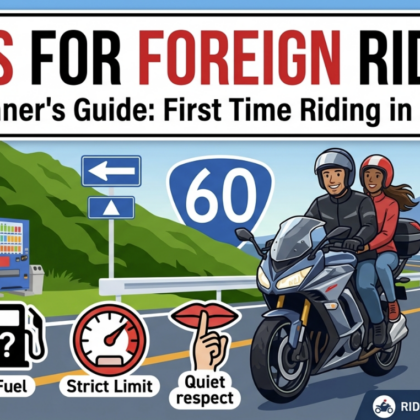

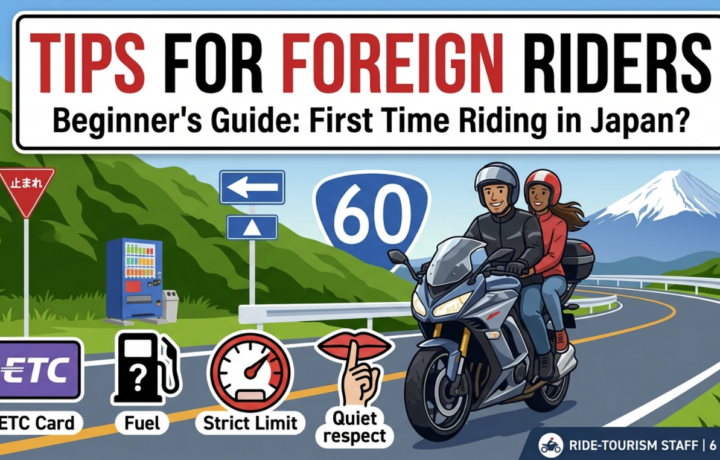
Tips for Foreign Riders · Beginner’s Guide
First Time Riding in Japan?
Here’s What to Expect.
Left-side traffic, mountain toll roads, and vending machines every two kilometres. Japan rewards prepared riders—and surprises everyone else.
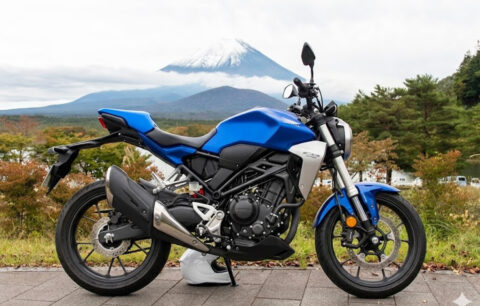
Japan is one of the most rewarding countries in the world to explore by motorcycle. The roads are well-maintained, drivers are disciplined, and within an hour of Tokyo you can be winding through mountain passes with views of Mt. Fuji. But riding here for the first time comes with a genuine learning curve—and knowing what to expect makes all the difference.
This guide covers the practical realities: traffic rules, road etiquette, tolls, navigation, and the small cultural details that catch first-timers off guard.
“Japan rewards riders who are prepared. The surprises are mostly pleasant—but a few require advance knowledge.”
The Big One: Riding on the Left
Japan drives on the left side of the road. If you come from a right-hand-traffic country—the USA, most of Europe, mainland Asia—this is the adjustment that demands the most attention, especially in the first hour.
The moments of highest risk are predictable: pulling out of a parking area, turning at an intersection, and riding after a rest stop when habits can temporarily reset. A useful technique is to repeat a simple mental cue before each move: “left side, left side.” It sounds simple, but it works.
The good news: Japan’s roads outside central Tokyo are genuinely calm. Coastal routes and mountain passes often carry minimal traffic, which gives you space to settle into the rhythm at your own pace.
Six Things That Surprise First-Timers
Toll roads are everywhere
Japan’s expressway network is excellent but heavily tolled. Your rental comes with an ETC card—use it. Cash toll lanes exist but are slower and less convenient.
Navigation is essential
Many rural roads and mountain routes are unsigned in English. Download Google Maps offline before you leave, or use a phone mount with data roaming enabled.
Petrol stations thin out in mountains
Fill up before entering mountain routes like Hakone or the Fuji Five Lakes area. Stations become sparse and may be closed outside daylight hours.
Speed limits are strictly enforced
Japan’s speed cameras are widespread and accurate. General roads: 60 km/h. Expressways: 100 km/h. Residential zones: 30–40 km/h. These are enforced.
Lane splitting is technically illegal
Unlike some Asian countries, lane filtering between stationary traffic is not legally permitted in Japan. In practice it happens, but ride at your own risk.
Vending machines are everywhere
This one is a genuine delight. Cold drinks, hot coffee, canned soup—roadside vending machines are a uniquely Japanese riding experience. Budget time for them.
Traffic Rules to Know
Japanese traffic law is detailed and generally well-observed. A few rules are worth knowing before you ride:
Key rules for riders
- Helmets are mandatory at all times — full-face or open-face, securely fastened
- Mobile phones while riding are illegal — use a mounted holder and voice navigation
- Drink-driving limits are extremely strict (0.03% BAC) — effectively zero tolerance
- At red lights, stopping behind the white line is expected and enforced
- Pedestrians have absolute right of way at crossings
- Riding on pavements (sidewalks) is prohibited
What to Do If You’re Stopped by Police
Traffic stops are uncommon for foreign riders, but they do happen. Japanese police are generally courteous and professional. Carry all required documents (licence, IDP, passport, rental agreement, insurance) and remain calm and cooperative.
Language is rarely a significant barrier—most officers will work patiently through basic communication. If you’re stopped near our operating area, you’re welcome to call us and we can assist with translation if needed.
Not Confident Yet? Ride With a Guide.
If the combination of left-side traffic, unfamiliar roads, and Japanese signage feels like too much for a first outing, our Guided Tour Plan is designed exactly for this situation. You ride your own motorcycle; our guide leads the way, handles navigation, and knows every rest stop, viewpoint, and fuel station on the route.
Many of our guests use a guided tour on day one to build confidence, then rent independently for the rest of their stay. It’s a practical approach, and one we genuinely recommend for first-timers.
Start with a Guided Ride
Build your confidence on day one with a local guide, then ride independently at your own pace.
View Tour Plans & Book