
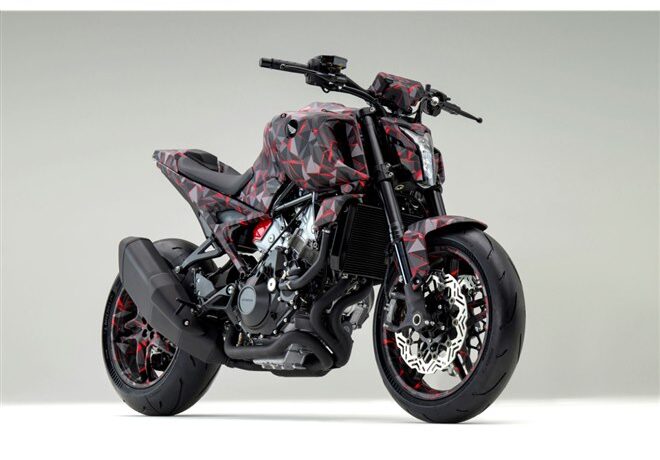
The HONDA V3R 900 E-Compressor is a hyper-naked prototype (pre-production model) that was first unveiled in 2025 at EICMA, the world’s largest international motorcycle show held annually in Milan, Italy every November.
What has drawn the most attention is its groundbreaking combination of a world-first electric compressor and a 75-degree V3 engine.
While the V3 engine itself—neither an inline-three nor a V4—is quite rare, the real highlight is undoubtedly the electric compressor.
This system reportedly allows boost pressure to be precisely controlled electronically, resulting in almost zero lag and delivering strong torque even at low RPMs. In other words, it achieves the best of both worlds:
the smooth usability of a naturally aspirated engine and the power of forced induction.
This “third approach” to forced induction—neither turbo nor supercharger—could have a major impact on the future of the motorcycle industry.
Developed under the unique concept of a “Non-Rail Roller Coaster,” the bike is rumored to deliver performance comparable to a 1200cc-class machine despite its 900cc displacement. Some overseas media even suggest it could produce around 150 horsepower.
Why Haven’t Electric Compressors Been Used Until Now?
To begin with, here’s a quick refresher:
- Exhaust-driven → Turbocharger
- Crankshaft-driven → Supercharger
(In motorcycles, superchargers are generally more common than turbos.)
An engine requires air to generate combustion.
When air is drawn in naturally, it’s called a naturally aspirated (NA) system. Turbochargers and superchargers, on the other hand, compress air and force it into the engine to improve combustion efficiency.
So with such a long history in both cars and motorcycles, why haven’t electric compressors been widely used until now?
It does seem like an obvious idea, so I looked into it myself.
Reason 1: Insufficient Electrical Power
The biggest issue has been power supply.
Compressing air and forcing it into the engine requires a significant amount of energy—specifically, a large burst of electrical current in an instant. Traditional 12V systems simply don’t provide enough power.
That’s why it made more sense to rely on turbochargers or superchargers, which use the engine’s own power.
Additionally, the common belief has long been that:
- Electric motors are less efficient
- Batteries are heavy and have limited output
So there was little incentive to adopt electric compressors in the first place.
Reason 2: Response Control Challenges
Another major hurdle is control.
An electric compressor must:
- Deliver boost instantly when the throttle is opened
- Avoid over-boosting
- Stay perfectly synchronized with engine RPM
This requires extremely advanced control systems. Conventional ECUs simply couldn’t handle this level of precision.
Even if such technology existed, it wouldn’t have been cost-effective—so manufacturers would just stick with turbos or superchargers.
Reason 3: Emissions Regulations
Electric forced induction also makes it more difficult to control the air-fuel ratio.
Combustion under boost becomes more sensitive, making it harder to meet strict emissions regulations. This has been another limiting factor.
So Why Is It Possible Now?
This is where things get really interesting.
Advances in Electrical Systems
With the rise of electric vehicles, higher-voltage systems like 48V have become more common. Compact yet powerful electric motors are now realistic even for motorcycles.
Improvements in Battery Technology
Modern lithium-ion batteries offer higher output and improved discharge performance.
Evolution of ECU Control
Today’s ECUs can perform millisecond-level control and even incorporate AI-like logic.
Personally, I drive a current-generation Civic, and HONDA’s technology is seriously impressive.
It almost feels like we’ve gone from “HONDA = engine company” to “HONDA = computer company.”
For better or worse… (laughs)
By the way, electric turbo systems have been seen in cars from Audi and Mercedes-Benz (based on F1 technology), but this is the first time we’re seeing something like this on a motorcycle.
Now that all the necessary technologies have finally matured, the concept has shifted to:
“Keep the usability of NA engines, but add boost only when needed—electronically.”
If this becomes mainstream, it could mark a major turning point—introducing a third type of forced induction to rival turbos and superchargers.
Price Estimate
While it’s difficult to make a direct comparison, similar models might include:
- Yamaha MT-10
~160 hp / approx. ¥1.8–2.2 million - Kawasaki Z H2
~200 hp / approx. ¥2.2–2.6 million
Based on this, a reasonable estimate would be around:
¥1.8–2.3 million
That said, mass-producing new technologies like the electric compressor and V3 engine will undoubtedly be expensive.
Still, it would be great if it could come in under ¥2 million.
If that happens… maybe we’ll even try to get one for our rental lineup. 😅